

Overview
Proton VPN is distinct in a crowded market because it feels less like a commercial product and more like a privacy utility. Based in Geneva, Switzerland, it operates under the umbrella of the Proton Foundation, a non-profit structure. This matters because it removes the pressure to squeeze profit from user data to please venture capitalists.
Most VPNs claim "no logs" but Proton backs it up with open-source code you can inspect yourself and independent security audits. It operates outside the 5 Eyes and 14 Eyes surveillance alliances, meaning they cannot be legally compelled to spy on you for foreign intelligence agencies.
While they are famous for their free tier—which is arguably the only "safe" free VPN in existence—the paid product is aimed squarely at two groups: privacy activists who actually fear for their safety, and power users who want 10 Gbps speeds without sacrificing anonymity.
Key Features
Secure Core Architecture
This is Proton’s answer to physical server seizure. Most VPNs route your traffic directly to the endpoint server. If that server is compromised, your traffic is visible.
Secure Core routes your traffic through multiple servers. The first hop is always a "hardened" server owned and operated physically by Proton. These are located in former military bunkers or high-security data centers in privacy-friendly nations like Iceland, Sweden, and Switzerland. Even if the exit node is compromised, your true IP remains hidden behind the hardened entry node.
VPN Accelerator
Encryption is heavy on your CPU. Proton developed "VPN Accelerator" technology to overcome single-thread processor limitations and reduce latency. It creates multiple processes for a single VPN connection. In testing, this results in significant speed boosts, particularly over the WireGuard protocol. They claim up to a 400% increase in some scenarios, making it a viable option for 10 Gbps connections.
Stealth Protocol & Censorship Resistance
For users in Russia, Iran, or behind strict corporate firewalls, standard VPN protocols are easily blocked. Proton’s Stealth Protocol wraps VPN packets in a layer of obfuscation that makes the traffic look like standard HTTPS web browsing.
On Android, they take this a step further with "Discreet App Icons," allowing you to change the Proton VPN app icon to look like a calculator or weather app. This protects users from physical device inspections by authorities.
NetShield
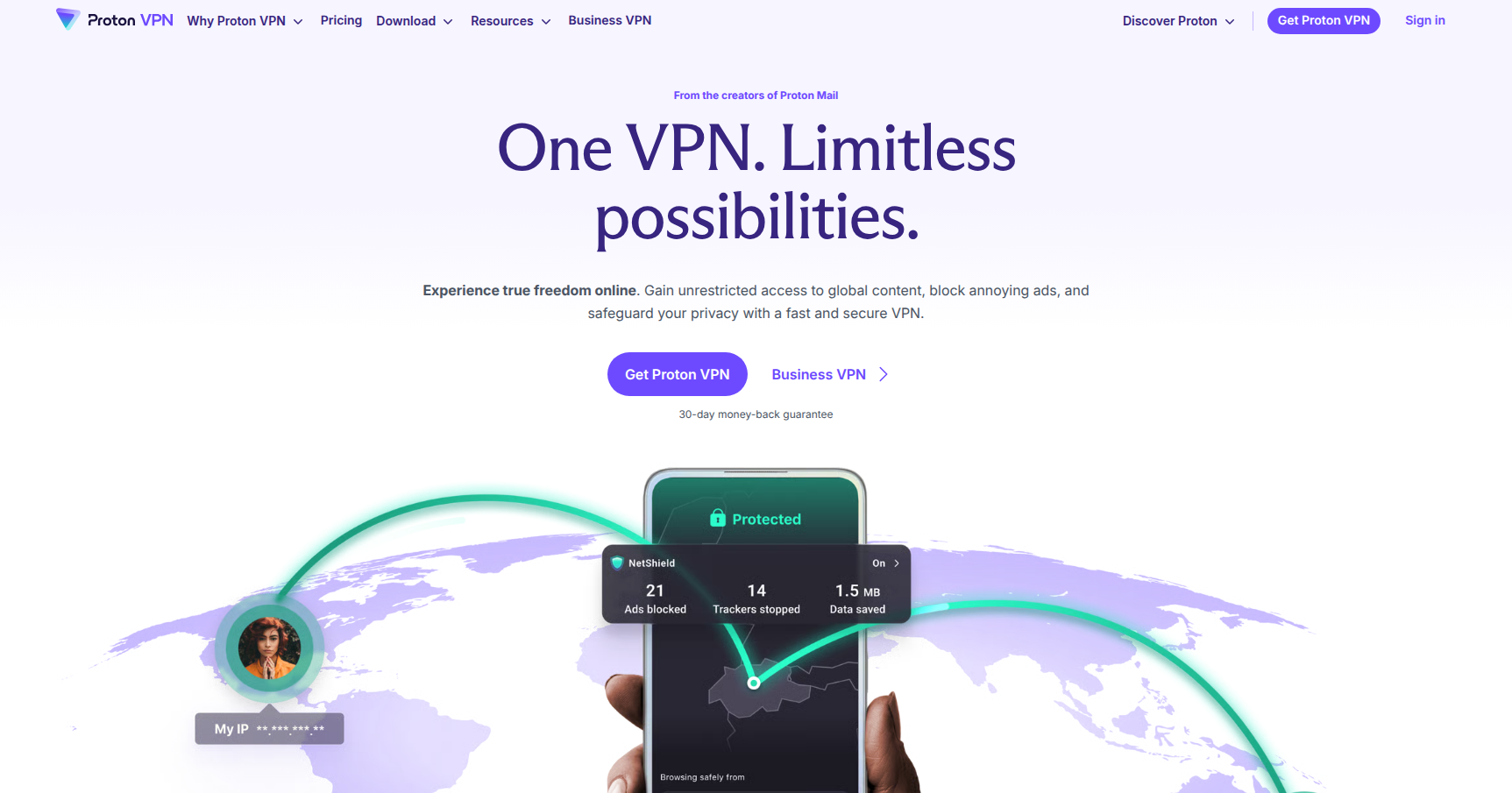
This is their DNS-based filtering system. It blocks malware, ads, and trackers at the network level before they even reach your device. Since it stops the ads from downloading, it speeds up browsing significantly on mobile connections.
Full Linux GUI
This deserves a specific mention because it is rare. Most VPNs treat Linux users as second-class citizens, forcing them to use command-line interfaces (CLI). Proton offers a fully functional Graphical User Interface for Linux, making it accessible for desktop users who aren't comfortable in a terminal.
Pricing
Proton uses a tiered model. The pricing is on the higher end of the market, reflecting the cost of owning their own hardware rather than renting cheap virtual servers.
1. Proton Free
- Cost: $0
- Specs: Unlimited bandwidth (no data caps). Access to servers in 5 countries (US, Netherlands, Japan, Romania, Poland).
- Catch: 1 device only, medium speeds, and you cannot choose the specific server (it auto-connects).
2. VPN Plus (The Standard Paid Plan)
- Monthly: $9.99
- 1-Year: $59.88 ($4.99/mo)
- 2-Year: $107.76 ($4.49/mo)
- Specs: 10 simultaneous connections, 10 Gbps servers in 110+ countries, Secure Core, NetShield, and streaming support.
3. Proton Unlimited (The Privacy Suite)
- 2-Year: $191.76 ($7.99/mo)
- Specs: Includes everything in VPN Plus, plus Proton Mail (500GB), Drive, Calendar, Pass, and Wallet.
Important Note on Refunds: They offer a 30-day money-back guarantee, but read the fine print. Users have reported that Proton sometimes prorates the refund based on the days you used. If you use it for 29 days and cancel, you might only get 1 day worth of money back.
Pros & Cons
Pros
- Legitimate Privacy: Swiss jurisdiction, open-source clients, and a non-profit ownership structure offer a level of trust most competitors cannot match.
- Speed: Between WireGuard and the VPN Accelerator, it saturates high-speed connections easily.
- Streaming Capabilities: It reliably unblocks stubborn libraries like Netflix Japan and UK-exclusive content.
- The "Unmetered" Free Tier: It is the best free option on the market simply because it doesn't sell your data or limit how much you can download.
- Linux Support: The full GUI is a major quality-of-life feature for Linux users.
Cons
- Price: At roughly $4.49/mo for the 2-year plan, it is nearly double the cost of budget providers like Surfshark.
- Support Speed: There is no live chat for free users. Even for paid users, email support can take 24 to 48 hours to resolve technical tickets.
- Refund Friction: The prorated refund policy is stricter than the "no questions asked" full refunds offered by competitors.
- Free Tier Control: You cannot manually select a specific server on the free plan; you are at the mercy of the auto-connect algorithm.
Verdict
Proton VPN is the "engineer's choice." It prioritizes architectural security, cryptography, and transparency over marketing gimmicks.
Buy it if: You are a journalist, activist, or power user who views privacy as an essential asset. It is also the best choice if you are already in the Proton ecosystem (Mail/Drive) and can bundle the subscription.
Skip it if: You are purely looking for the cheapest way to watch US Netflix. If budget is your primary concern, there are cheaper options that handle streaming just fine.
Ultimately, you are paying a "Swiss premium" here. For most people who care about their digital footprint, that premium is worth it.