

Overview
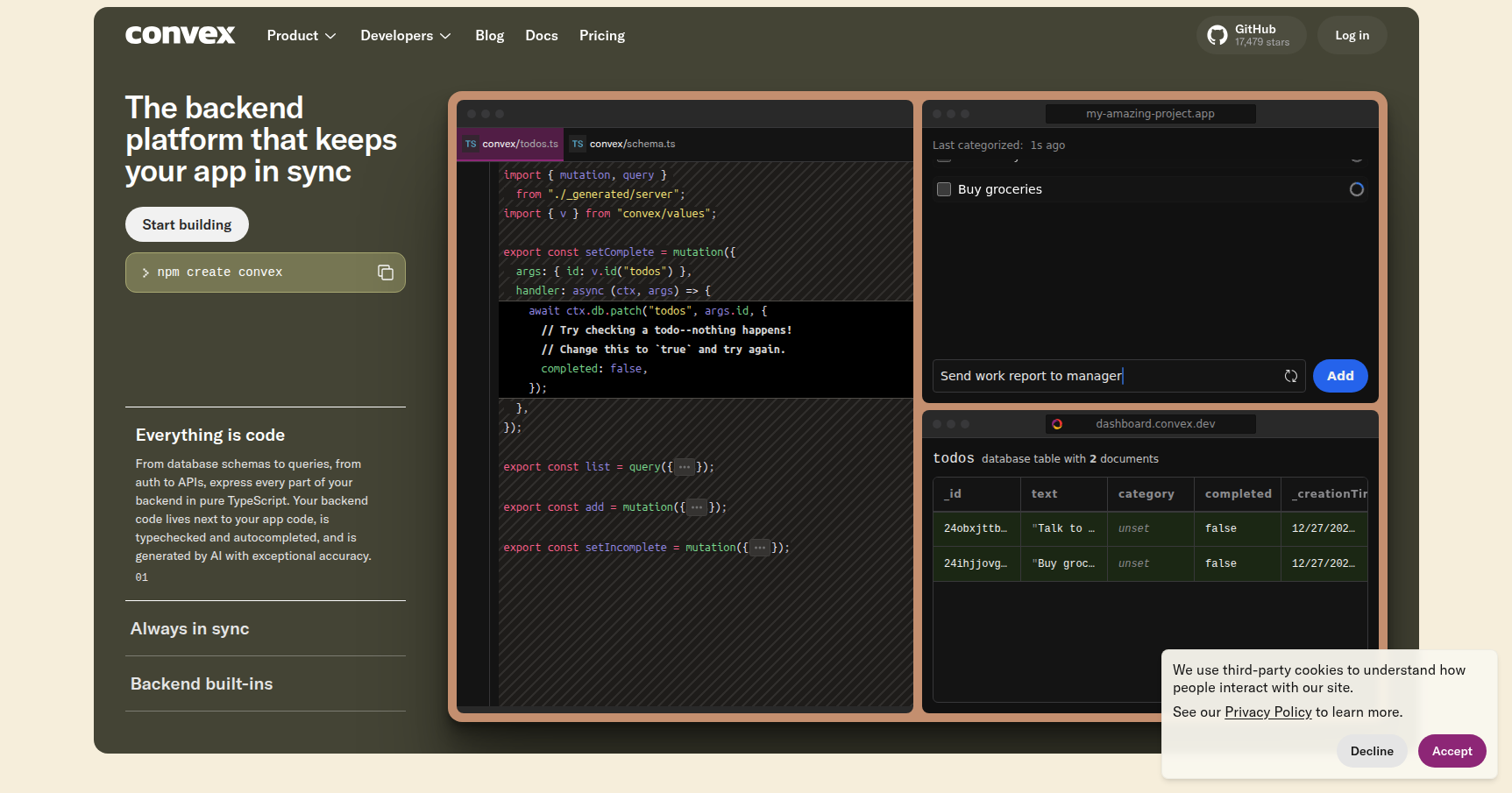
Convex is a Backend-as-a-Service (BaaS) that attempts to solve the "glue code" problem in full-stack development. If you have ever spent days setting up a Postgres database, configuring a Redis cache, writing API resolvers, and managing TypeORM or Prisma just to get a simple list of items on a screen, Convex is built to remove that entire layer.
It bundles a transactional, document-relational database with serverless functions and file storage into a single TypeScript environment. The core philosophy here is "reactivity." Unlike a standard SQL database where your frontend has to ask for data (polling), Convex pushes data to your frontend via WebSockets whenever it changes.
This platform is specifically targeted at full-stack TypeScript developers and startups building collaborative tools (like project managers or whiteboards) where real-time state is non-negotiable. It is also gaining traction among AI engineers because it handles long-running jobs and vector search natively.
Key Features
The "Reactive" Database
This is the main draw. Convex functions act as your API and your database queries simultaneously. When you write a query in Convex, your frontend "subscribes" to it. If a mutation changes the underlying data, Convex automatically pushes the new result to the client. You do not need useEffect hooks or manual subscription management to keep your UI in sync. It creates that "multiplayer by default" feel seen in apps like Figma or Linear.
End-to-End Type Safety Because both your backend logic and your database schema are defined in TypeScript, the type safety is excellent. If you change a field name in your database schema, your frontend code immediately breaks in your IDE (VS Code, etc.) with a red squiggly line. There is no translation layer or code generation step required to keep the frontend and backend types aligned.
Automatic Caching Convex handles caching logic for you. It automatically caches the results of your query functions. If the data hasn't changed, the query returns the cached result instantly. You do not need to spin up a Redis instance or write invalidation logic. The system knows exactly which data drives which query and invalidates the cache only when necessary.
Vector Search & AI Integration For AI applications, Convex includes native vector search. You can store embeddings directly in the database and perform semantic searches without an external vector DB like Pinecone. It also supports "Actions," which are node-based functions designed for long-running operations like calling OpenAI or Anthropic APIs, preventing timeouts that usually plague serverless environments.
Convex Auth Historically, users had to integrate Clerk or Auth0. Convex now offers a built-in Auth library (currently in Beta) that lives entirely within your backend. It handles Magic Links, OTPs, and OAuth via over 80 providers. This reduces the number of third-party services you need to pay for and configure just to log a user in.
Pricing
Convex operates on a "Scale-to-Zero" model. This means you aren't paying for a server that sits idle.
Free / Starter Plan ($0/mo base) Perfect for hobby projects or MVPs.
- Team: Up to 6 members.
- Database: 0.5 GB storage.
- Compute: 1 million function calls per month and 20 GB-hours for actions.
- Overage: If you exceed these limits, you move to the Starter plan where you pay purely for usage (approx. $2.20 per additional 1 million function calls).
Professional Plan ($25 per member/mo) Designed for production apps.
- Included Usage: 25 million function calls/mo, 50 GB storage, 250 GB-hours action compute.
- Features: Adds log streaming (to Datadog/Sentry), preview deployments, unlimited team members, audit logs, and automatic backups.
Startup Program If you are a funded startup, apply for this. They offer 1 year of the Professional plan for free (waiving the seat fees) and a 30% discount on usage-based fees.
Pros & Cons
Pros
- Development Velocity: The speed at which you can ship features is genuinely higher. Removing the separation between "API" and "Database" saves significant boilerplate.
- Real-Time Out of the Box: You get WebSocket-based live updates for free. You don't have to architect a complex subscription system.
- Maintenance: No database provisioning, connection pooling, or migration files to manage.
- ACID Compliance: Despite looking like a NoSQL JSON store, it supports serializable ACID transactions. You won't end up with corrupted data states during high concurrency.
Cons
- Vendor Lock-in: This is the biggest trade-off. Your backend logic is written specifically for the Convex runtime. You cannot simply "export" your code and run it on a standard Node.js server later. Migrating away would require a rewrite of your data access layer.
- Query Limitations: While it calls itself relational, you cannot perform complex SQL-style joins efficiently on massive datasets. You often have to do joins in your application logic (TypeScript), which can be a bottleneck for data-heavy analytics apps.
- Cost at Scale: For extremely high-volume applications, paying per function call can become more expensive than renting a fixed-cost VPS or dedicated database instance.
Verdict
Convex is currently the best-in-class option for TypeScript-heavy startups building collaborative or interactive products. If your app involves users seeing live data updates (chats, dashboards, task managers, AI generators), the developer experience Convex provides is difficult to beat.
However, if you are building a traditional CRUD application where real-time updates aren't necessary, or if you have a strict requirement to use standard SQL for complex reporting, a traditional setup like Supabase or a managed Postgres instance might still be the safer, cheaper bet.