
Overview
Early 2026 and the "Twilio tax" is finally becoming optional. For the last decade developers have been stuck paying high markups on carrier fees just for the privilege of using a decent API. Sent.dm has gained traction this year by taking a different approach. It functions as a unified messaging infrastructure that sits between your code and the chaotic world of carrier networks.
The core premise is simple: you send a message to a phone number and Sent.dm figures out how to deliver it. It automatically detects if the user is on WhatsApp, iMessage, or standard SMS. It routes the message to the cheapest or highest-fidelity channel available and handles the formatting automatically.
This tool is built for SaaS developers and Customer Ops teams who are tired of managing three different APIs for one notification system. If you are building "AI Employees" that need to handle two-way negotiation or high-volume transactional alerts without burning your budget on middleware markups this is likely the stack you should be looking at.
Key Features
The "AI Employee" Suite
This is the flagship update for 2026. Sent.dm isn't just a pipe for text anymore. It acts as a hosting environment for autonomous agents. You can deploy agents powered by Claude 4.5 Opus for handling long, context-heavy support threads or GPT-5.2 for logic-heavy tasks like appointment booking and objection handling.
The system handles the "state" of the conversation. You don't need to build a separate vector database to remember what the customer said three messages ago. The platform manages the thread history and injects it into the context window automatically.
Intelligent Channel Routing & Content Transformation
This solves the fragmentation headache. When you push a message via the API Sent.dm checks the destination number.
- If it is a WhatsApp number it sends a rich media template.
- If that fails or isn't available it falls back to SMS.
The clever part is the AI Content Transformation. You write one message payload. If it routes to WhatsApp the AI keeps the rich formatting and images. If it falls back to SMS the AI automatically rewrites and shortens the text to fit character limits while preserving the core information. No more manual "if/else" logic in your code for message length.
Sender Reputation Monitoring
Carrier filtering is aggressive. Sent.dm treats your phone numbers like email domains. It provides a dashboard tracking block rates and spam reports in real-time. If a number starts getting flagged the system alerts you immediately so you can pause the campaign or rotate the number before the carrier kills it entirely. This is essential for high-volume marketers navigating A2P 10DLC compliance.
Model-Agnostic Logic (The Frontier Three)
Sent.dm doesn't lock you into one LLM provider. They have integrated the latest "Frontier Three" models directly into the routing logic:
- Gemini 3 Pro: Used automatically if the user sends an image or voice note that needs analysis.
- GPT-5.2: Used for the "Thinking" architecture required for complex booking logic.
- Llama 4: Available for enterprise users who need on-premise style privacy/data sovereignty.
Pricing
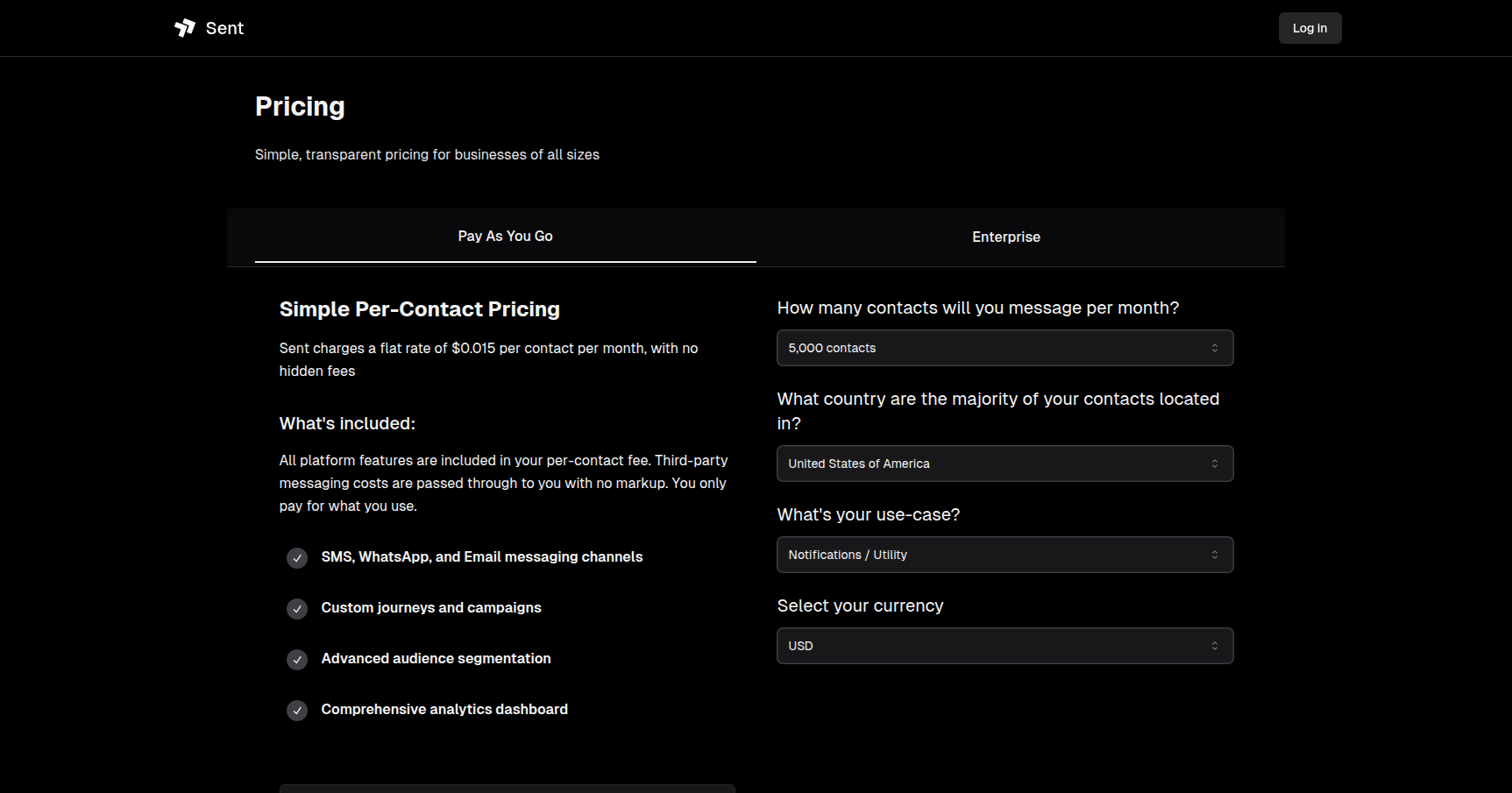
Sent.dm uses a "pass-through" model. They do not mark up the carrier fees. You pay the carrier directly via their platform and pay Sent.dm a flat platform fee.
The Platform Fee:
- $0.015 per contact / month: This is a flat rate based on the size of your address book.
Pass-Through Costs (Estimated as of Dec 2025):
- US SMS (10DLC): ~$0.0030 per message (Standard carrier rate).
- WhatsApp: ~$0.04 per business-initiated conversation.
- Phone Numbers: $5/mo for Toll-Free, $15/mo for 10DLC local.
AI Add-ons:
- Unlimited Plan ($97/mo per sub-account): This covers the compute for the AI agents so you aren't paying per token for the OpenAI/Anthropic usage. This is a steal if you have high-volume conversational agents.
Developer Sandbox:
- There is no "free forever" tier for production but they offer a robust Developer Sandbox with test credits to build out your integration before adding a credit card.
Pros & Cons
Pros
- Significant Cost Savings: By removing the middleware markup users report reducing their bill by 80-90% compared to legacy aggregators.
- DevEx: The SDKs (Python, Node, Ruby) are clean. The documentation is written for engineers, not sales people.
- Reliability: The automatic fallback logic (WhatsApp to SMS) pushes delivery rates above 98%.
- Model Flexibility: Being able to toggle between Claude 4.5 and GPT-5.2 based on the "vibe" of the conversation is excellent.
Cons
- Regulatory Friction: The platform doesn't hide the complexity of 10DLC or WhatsApp verification. You still have to do the paperwork. It is a pain but that is the industry reality.
- Support Tiers: Live human support is gated behind Enterprise plans. If you are on the base plan you are relying on docs and their AI bot.
- International Rate Variance: While the platform fee is flat international SMS rates are volatile. You need to watch your usage if you are sending globally to avoid bill shock.
Verdict
Sent.dm is the infrastructure layer that modern SaaS applications have been waiting for. It strips away the unnecessary markup of legacy providers while adding the AI intelligence required for 2026 customer engagement.
Buy it if: You are a developer or Ops lead building high-volume transactional alerts or AI-driven customer support agents and want to cut costs while improving reliability.
Skip it if: You are a small local business that just wants to send 50 marketing texts a month manually. The setup complexity for 10DLC isn't worth it for very low volumes.