
Overview
If you are building a SaaS or a digital product, you usually hit a specific wall eventually. You start making sales, which is great, until you realize you are now liable for VAT in Germany, GST in Australia, and sales tax in Ohio.
Creem is a "Financial Operating System" and, more importantly, a Merchant of Record (MoR). It is designed to solve that tax compliance panic. Unlike a standard payment gateway like Stripe (where you handle the taxes), Creem effectively resells your product to the customer. They take the money, they handle the legal liability, and they remit the taxes to the various global governments. You just get a payout.
It is positioning itself as a leaner, more transparent alternative to heavyweights like Paddle and Lemon Squeezy. It targets early-stage SaaS founders, AI startups, and indie hackers who want to sell globally without hiring a finance team. If you want to accept payments in 80+ currencies and 100+ countries without the administrative bloat, Creem is the modern "plug-and-play" option.
Key Features
True Merchant of Record (MoR) Liability
This is the heavy lifting feature. When a customer buys your software, they are technically buying it from Creem. This means Creem is the entity responsible for calculating, collecting, and remitting sales tax and VAT in over 100 countries. You do not need to register for tax IDs in Europe or Asia. You integrate Creem, and the compliance headache is off your plate.
Automated Revenue Splits
For distributed teams or co-founded projects, this feature is a massive time-saver. You can configure rules to split revenue automatically at the source. If you have a co-founder, an affiliate, or a platform partner, you set the percentage once. When a sale comes in, Creem routes the funds to the respective accounts instantly. It eliminates the end-of-month spreadsheet math where you try to calculate who is owed what.
AI Financial Assistant
Creem leans heavily into the "AI OS" branding. It includes a built-in assistant that lets you query your financial data using natural language. Instead of digging through CSV exports to find trends, you can ask questions like "Which country had the highest conversion rate this week?" or "What is my current churn rate?" It basically acts as a junior CFO in your dashboard.
Negotiation & "Build in Public" Tools
Creem includes a few unique tools tailored to the modern indie hacker.
- Salesnip Integration: This allows for AI-powered price negotiations. An AI agent can negotiate with a potential buyer and, once a price is agreed upon, generate a secure checkout link.
- Public Dashboards: If you are part of the "build in public" movement, Creem lets you generate verified earnings dashboards to share with your community on Twitter/X or LinkedIn.
Pricing
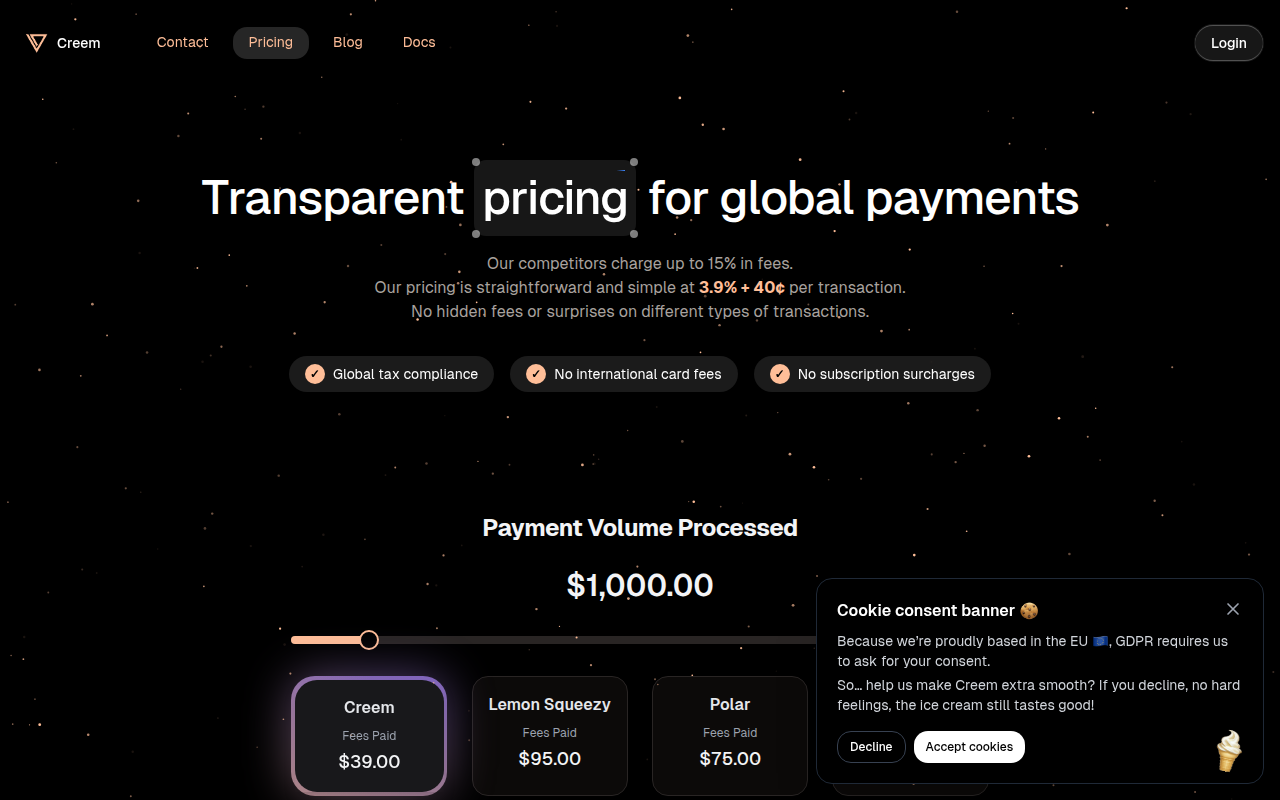
Creem’s main selling point is pricing transparency. They attack competitors on "hidden fees" for things like cross-border transactions or currency conversion.
The Cost:
- 3.9% + $0.40 per transaction.
What is included (0% extra fees):
- International Cards: No surcharge for non-US cards.
- Subscription Recurring Payments: No extra fees.
- Payouts: No fees for transferring money to your bank account.
- PayPal: No surcharge if a customer pays via PayPal.
There is no monthly subscription cost. It is purely pay-as-you-go. Note that while they previously offered a "First $1,000 free" promo, current research indicates they have shifted to this flat-rate model for all users to sustain the 0% surcharge structure.
Pros & Cons
The Good
- Transparent Pricing: The flat rate is genuinely flat. Competitors often advertise a similar base rate but tack on 1.5% for international cards, which kills margin on global SaaS products. Creem absorbs that.
- Developer Experience: The API is modern and the setup is incredibly fast. Users report going from sign-up to processing live payments in under 10 minutes.
- Founder Support: As a smaller, newer player, the support is often handled by the engineers and founders themselves. You aren't shouting into a void; you get actual technical help.
- Tax Autopilot: For a solo dev, having VAT and GST handled automatically is worth the 3.9% fee alone.
The Bad
- Early Stage Quirks: It is a 2024 product. Users have noted minor UI bugs, like duplicate items in the product creator or dashboard glitches. It lacks the rock-solid maturity of a ten-year-old platform.
- Limited Reach (Comparatively): They support roughly 100 countries. While that covers most major markets, competitors like Paddle or Dodo Payments cover 200+. If you have a specific customer base in niche regions, check the coverage map first.
- Missing Features: Some advanced roadmap items, like crypto payments and dynamic price engines, are marked as "Coming Soon." You are buying into what is there now, not the future promise.
Verdict
Creem is an excellent choice for bootstrapped SaaS founders, AI startups, and digital creators who are launching today and want to avoid "tax hell."
If you are just starting out, the straightforward 3.9% pricing is likely cheaper than competitors once you factor in cross-border fees. The developer experience is fresh, and the revenue split feature is perfect for small teams.
However, if you are a large enterprise requiring absolute platform maturity or need to sell into highly regulated or obscure global markets immediately, you might stick with the legacy giants for another year while Creem matures. For everyone else building the next big SaaS, Creem is a very strong alternative to Lemon Squeezy and Paddle.