

Overview
If you have ever tried to sell a digital product globally, you know the headache isn't writing the code; it is handling the taxes. You hook up Stripe, but suddenly you are responsible for calculating, collecting, and remitting VAT in Europe, GST in Australia, and sales tax in the US.
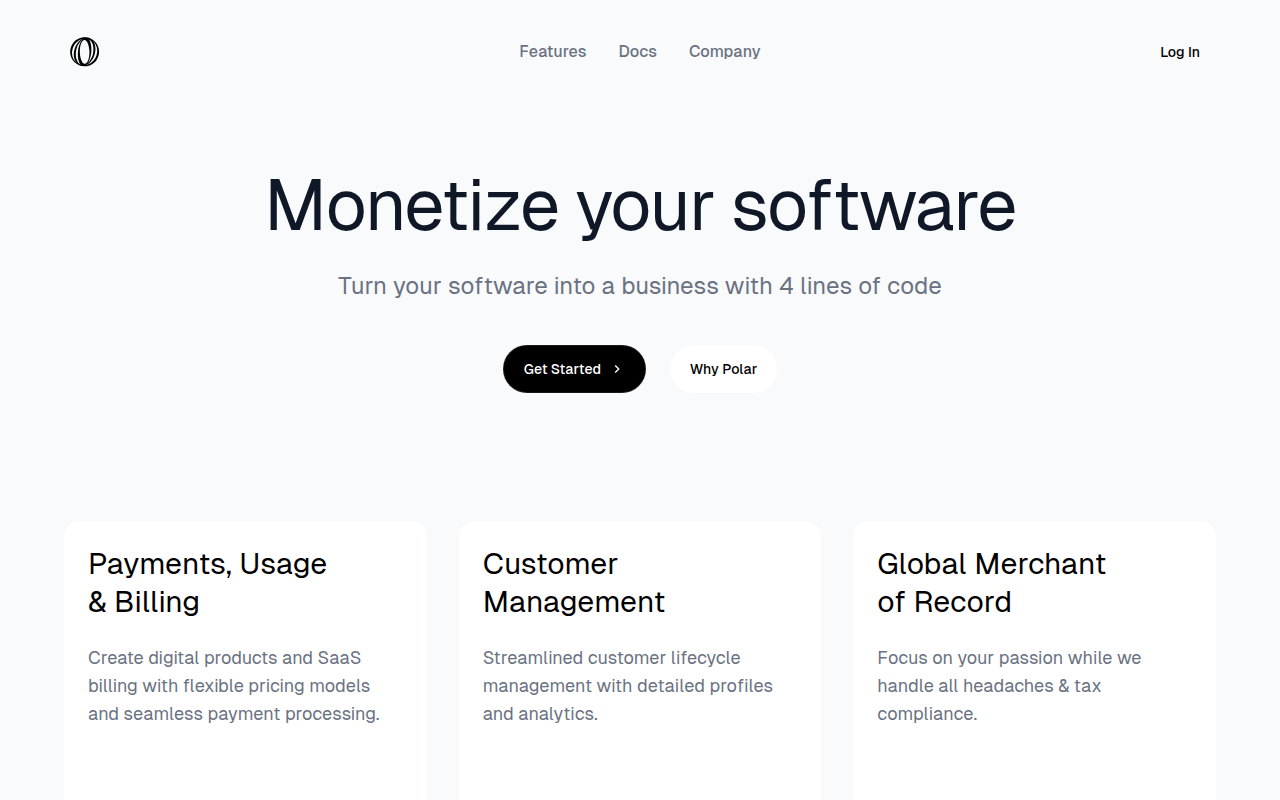
Polar.sh solves this by acting as a Merchant of Record (MoR).
Think of it as a layer that sits on top of Stripe. When a customer buys your SaaS subscription or download, they are technically buying it from Polar. Polar handles the liability, the tax remittance across 100+ countries, and the invoices. For you, it creates a "monetization in a box" experience. You get a clean API to accept payments and the platform handles the boring legal compliance.
It is built specifically for developers, open-source maintainers, and indie hackers who want the "Vercel experience" but for billing. It is also fully open-source (Apache 2.0), which gives it a transparency edge over closed-source competitors like Lemon Squeezy or Paddle.
Key Features
1. The Merchant of Record Model
This is the heavy lifter. Instead of you spending weeks setting up tax entities or integrating a third-party tax calculator like TaxJar, Polar does it automatically. They calculate the correct tax based on the buyer's location, collect it, and remit it to the proper authorities. You just get the net revenue paid out to your bank account.
2. Automated Entitlements
Polar shines in how it connects payment to access. Usually, you have to write "glue code" that listens for a Stripe webhook and then triggers a database update. Polar automates this entitlement layer.
- GitHub: It can automatically invite a paying user to a private repository.
- Discord: It can assign a specific role to a user upon purchase.
- License Keys: It generates and manages license keys for desktop software.
- File Downloads: It handles secure file delivery for digital creators.
3. Usage-Based & AI Billing
For the AI and LLM crowd, Polar has built-in ingestion strategies for token-based billing. Because it integrates easily with tools like the Vercel AI SDK, you can set up a "pay-as-you-go" model where you bill customers based exactly on their compute or token usage. It also supports standard seat-based billing with tiered discounts, covering 99% of SaaS pricing models.
4. Open Source & Issue Funding
Polar started with a focus on funding open-source work, and that DNA is still there. They have a unique "Issue Funding" feature where users can pledge money to specific GitHub issues. Once the maintainer closes the issue (completes the work), they can claim the funds. Because the entire platform is open-source, you can audit their billing engine yourself, providing a "no-lock-in" safety net that doesn't exist with proprietary alternatives.
Pricing
Polar operates on a transaction-fee model. There are no monthly subscription costs to use the platform. If you don't make sales, you don't pay anything.
- The Fee: 4% + 40¢ per successful transaction.
- What that covers: This fee is inclusive of the underlying payment processor fees (Stripe usually charges 2.9% + 30¢).
- The Math: effectively, you are paying Polar about 1.1% + 10¢ on top of standard processing rates to handle all your global tax compliance and billing logic.
- Payouts: Money is sent to you via Stripe Connect. Standard Stripe cross-border fees may apply depending on your bank's location.
- Disputes: If a customer initiates a chargeback, there is a standard $15 dispute fee.
Pros & Cons
The Good
- Speed to Code: The SDKs are ergonomic. You can often get a checkout flow running in your Next.js or Python app with about 6 lines of code.
- Global Tax Handling: For a solo founder, offloading VAT/GST liability is worth every penny of the 4% fee.
- Developer Experience: The dashboard is clean, fast, and intuitive. It feels like a tool built by engineers for engineers.
- Open Source: Knowing the code is public builds trust. If the company disappears, the logic remains available.
The Bad
- Platform Maturity: They are a younger company (founded ~2023). While stable, they don't have the decade-long track record of Paddle.
- Payout Reviews: Like many financial platforms, they have fraud detection triggers. Some users have reported pauses in payouts while their accounts undergo manual review, which can be stressful for cash-strapped startups.
- Fewer Integrations: If you rely on complex marketing automation (like deeply integrated email funnels via HubSpot or ConvertKit), you might find Polar's native integrations a bit sparse compared to Lemon Squeezy.
Verdict
If you are an indie hacker, a solo developer, or an open-source maintainer launching a product today, Polar.sh is likely your best option.
The slight premium you pay (approx. 1.1% over raw Stripe) is negligible compared to the cost of hiring an accountant to handle EU VAT returns. The API is superior to legacy MoRs, and the open-source nature aligns perfectly with the modern dev stack.
However, if you are a large enterprise requiring complex Salesforce integrations or immediate, high-volume payout guarantees without risk reviews, you might still want to look at the legacy giants like Paddle. For everyone else building the next big SaaS, start here.